
In the current calendar year, small and medium enterprises (SMEs) have witnessed an impressive surge in initial public offerings (IPOs), surpassing the 2018 record. Over 150 SME IPOs have been introduced to the market, breaking the previous record of 141 set in 2018. According to data from PRIME Database, a primary market tracking firm, 147 companies successfully concluded their debut share sales by the end of October, raising a cumulative Rs 3,727 crore.

South Korea's move to ban stock short-selling may further delay its quest to bag an 'upgrade' to 'developed market' status from global index provider MSCI, said analysts. South Korea will prohibit stock short-selling until June 2024 to allow its regulators to "actively" improve rules and systems. South Korea is currently classified as an 'emerging market (EM)' alongside India, China and Taiwan in MSCI indices.

This is the case even though the benchmark index is only 5 per cent below its all-time high. The list of stocks trading at a discount primarily consists companies in the automotive, banking, oil and gas, insurance, healthcare, and metal sectors.
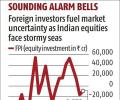
Foreign portfolio investors (FPIs) have withdrawn Rs 25,305 crore from domestic markets since September. FPIs were net sellers in the first two months of 2023, but from March to August, they purchased equities worth Rs 1.7 trillion. This selling trend has caused the National Stock Exchange Nifty Index to decline by 3.2 per cent from its September highs. FPI selling initially began in September as profit-taking but intensified due to rising US bond yields and uncertainty regarding the rate hike trajectory.

Draft Red Herring Prospectus (DRHP) filing continued to be robust in October, signifying the optimism in the initial public offer (IPO) market despite the recent turbulence in equities. In October, 17 companies filed their offer documents for IPOs. The rush in filings has made August-October 2023 the best three-month period for DRHP filings since July-September 2021.

The fees charged by investment banks to manage initial public offerings (IPOs) have increased to an average 3.23 per cent of the issue size this calendar year, the highest since 2020. The average fee is up 8 per cent compared to last year, when it stood at 2.99 per cent. The investment banking fees have increased as the average IPO size has shrunk this year.

As many as 267 of 453 companies from the BSE500 index are trading above their consensus price targets, according to the data compiled by Bloomberg. Not all companies in the BSE500 index are tracked by analysts.
As many as 31 mainboard IPOs raised a cumulative Rs 26,272 crore in this period, according to Prime Database. During the April-September 2007 bull run, 48 IPOs totalling Rs 21,243 crore were launched. The number of deals in H1FY24 was 2.2 times that of the same period of the last fiscal year, but the amount raised was 26 per cent lower.

Nextbillion Technology (Groww), the venture capital-backed broking platform, has dislodged Zerodha Broking as India's largest brokerage in terms of number of active clients. Groww had 6.63 million active clients at the end of September, as against Zerodha's 6.48 million, ending the latter's long run at the top. AngelOne and RKSV Securities (Upstox) were ranked third and fourth with 4.86 million and 2.19 million active clients, according to data available on the National Stock Exchange (NSE).

Jefferies, IIFL, and JM Financial - none of which were in the top five last year - have now claimed the top spots in the league tables for equity capital markets (ECM) during the first nine months of calendar year 2023 (CY23), a period characterised by small- and mid-sized transactions. This shift marks a significant change, with these firms outperforming the bulge-bracket investment banks. According to data provided by Refinitiv, Jefferies leads the domestic ECM market, having handled share sales worth $2.3 billion, representing 12.4 per cent of the total volume of $18.4 billion for ECM transactions.
The country's most valuable lender HDFC Bank can perhaps no longer claim to be a favourite of foreign portfolio investors (FPIs). Two data indicators, both somewhat interconnected, point to this - the diminishing premium of HDFC Bank's American depositary receipts (ADRs) compared to local shares, and the ample investment opportunities available to FPIs in the domestic market. The ADR premium has shrunk to below 5 per cent, down from over 30 per cent in March 2021, and even lower than recent levels.

The broking industry's pecking order is set to change with Groww, a fin-tech startup from Bengaluru, poised to topple the industry's poster boy, Zerodha, as the leading brokerage in the number of active investors. According to data provided by the portal Topsharebrokers.com, Zerodha has 6.32 million active investors, while Groww is at 5.99 million. It is projected that Groww, which has grown at a much faster clip over the past two years, will surpass Zerodha this month, or next month.

Stake sales by promoters and private equity/venture capital (PE/VC) investors this year are already exceeding twice those of last year. So far this calendar year, the selling stands at over Rs 87,400 crore, 2.2 times the Rs 39,700 crore worth of shares sold by promoters and PE/VCs in 2022. This year's tally has received a boost from stake sales by Adani group promoters.

Deteriorating ties between India and Canada could have a bearing on flows into the domestic capital markets. At present, Canada is the seventh largest country for foreign portfolio investor (FPI) flows into India. According to the National Securities Depository Ltd (NSDL), the assets under custody (AUC) of FPIs domiciled in Canada stood at nearly Rs 1.8 trillion ($21 billion) at the end of August. Almost 85 per cent of these investments are in listed equity, while the remaining in debt and hybrid instruments.
With the Nifty50 surging past the 20,000 mark, the markets are experiencing a spate of initial public offerings (IPOs) with four issues set to raise over Rs 4,673 crore this week. Another quartet, cumulatively worth Rs 3,000 crore, is expected to launch next week. Companies like RR Kabel, SAMHI Hotels, Zaggle Prepaid Ocean Services, and Yatra Online are set to hit the primary market this week, while Signature Global, Updater Services, Sai Silks (Kalamandir), and Vaibhav Jewellers are slated for next week. This flurry of activity is driven by multiple factors including buoyant market conditions, increased demand for IPOs, and specific rule on the disclosure of quarterly financials.

Shares of HDFC Bank will witness massive inflows totalling $600 million from passive trackers this week, predict analysts. This influx is attributed to the rebalancing activities in the S&B BSE Sensex and the Financial Times Stock Exchange (FTSE) indices. The Sensex is set for its quarterly rebalancing act on September 15 (date of adjustment), resulting in inflows of $102 million (approximately Rs 850 crore).

The OCCRP report alleges that at one point, EIFF and EMRF held free-floating shares ranging from 8 per cent to nearly 14 per cent in the four Adani Group companies.

Polycab India, Power Finance Corporation, Shriram Finance, and Union Bank of India appear poised to transition from the mid-cap to the large-cap category within the domestic mutual fund industry. Their market capitalisation (m-cap) now ranks among the top 100, which is the threshold for the large-cap universe defined by the Securities and Exchange Board of India.
Water projects firm Vishnu Prakash R Punglia, the 20th company to launch its IPO in the current year, saw its shares closing at a 47 per cent gain over its issue price on Tuesday. Such a huge one-day pop is considered rare; however, it has become the norm this year. The average listing-day gain for these 20 IPOs in 2023 is 34 per cent, and their average gain to date stands at 46 per cent.
Notwithstanding the ongoing decline in equity markets week after week, August has proven to be the most successful since December for initial public offerings (IPOs). In August of this year, six companies have collectively raised approximately Rs 4,269 crore through IPOs.
